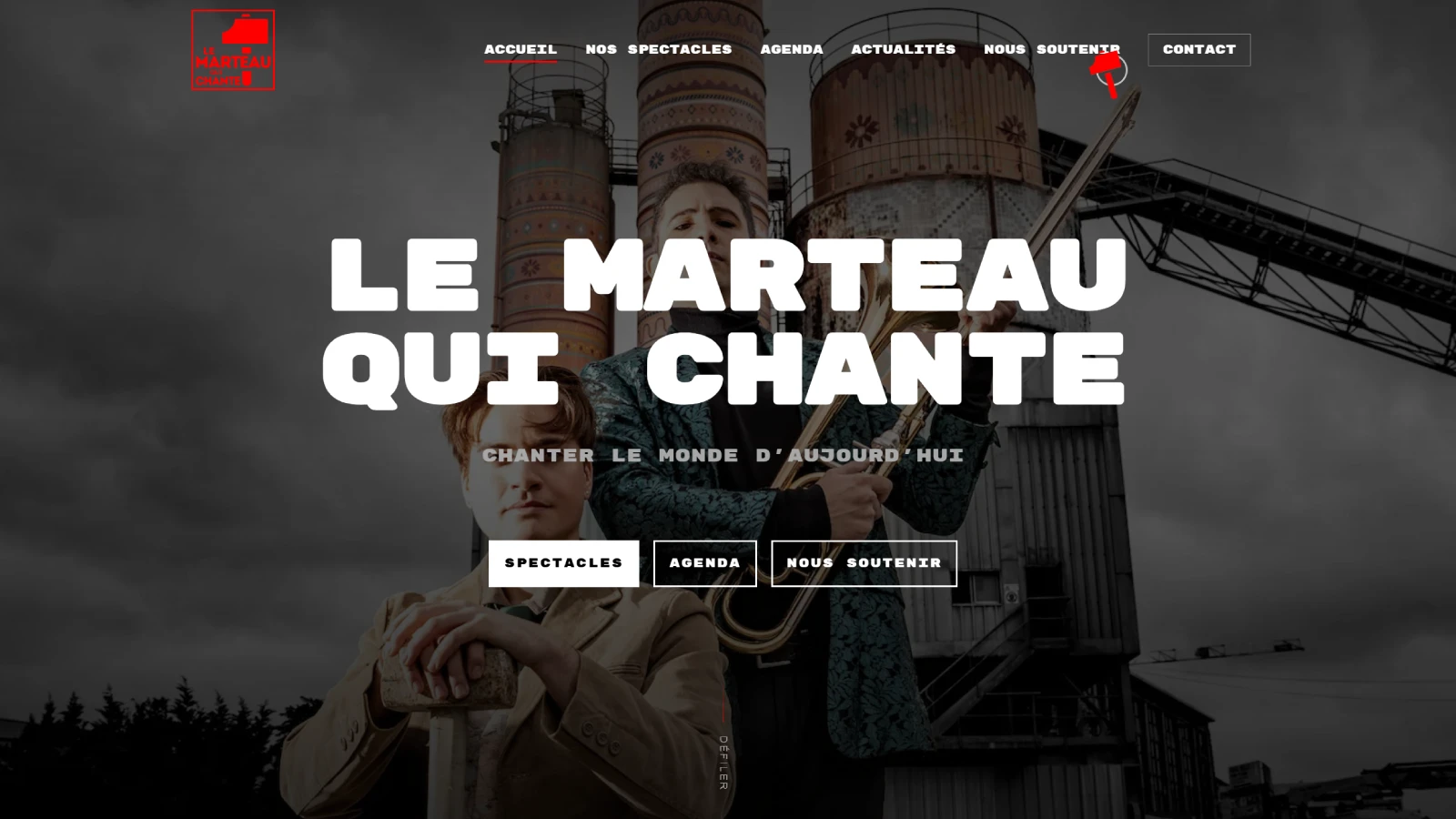
The brief
Le Marteau qui Chante started in Paris in 2025 and runs the whole operatic pipeline in-house: libretto, score, staging. Their sound is industrial percussion hammered out of recycled metal, through a partnership with Derichebourg Environment. The old site did none of it justice. It ran on a legacy commercial page builder packed with third-party plugins for the original developer, not the company.
The brief was a from-scratch rebuild of
marteauquichante.com on WordPress. The site had to
read as a credible card to hand a festival programmer or artistic
director, and the two flagship creations,
Le Phlégéthon and Contre-Ut Man, had to pull
booking inquiries without leaking the full artistic dossiers. The
third ask was backend autonomy: the team updates residencies,
media, and the performance schedule without touching code.
The approach
I rebuilt the whole thing on native WordPress Full Site Editing and dropped the page builder. That decision is where most of the performance and editability wins came from: clean semantic HTML, no proprietary lock-in, and the client inside the standard block editor instead of learning a third-party interface. The harder part was making a native block theme carry a design that felt industrial and tactile, something closer to the white-cube language of the Palais de Tokyo or La Station than to a theatre template.
A few custom frontend mechanics, all hand-coded so they wouldn't cost Core Web Vitals:
Letter hover splitting. Each character animates independently when you hover, so words come apart and reassemble with a staggered rhythm. The spacing between words stays intact, and screen readers still hear the heading read as a whole sentence rather than a run of single letters.
Hero parallax. The industrial texture in the hero shifts gently as you scroll, so the page reads as having depth without the backdrop sliding out of view or dragging scroll performance down.
The hammer cursor. On desktop, the cursor is a hammer trailed by a red ring that lags behind it. The ring expands over links and buttons, and on click the hammer swings and stamps a brief impact mark onto the page. Touch devices keep their native cursor behaviour and skip the effect entirely.
Conversion flows. Dossier download CTAs for the two flagship creations route to a clean contact form, with a contextual URL parameter pre-filling the inquiry subject, so a production request lands in the admin inbox already labelled. Audio players stay manual and self-hosted, so no autoplay and no streaming weight on the page.
The result
Stripping the legacy builder for native blocks landed the site in the upper band of the Lighthouse audit, built to load fast even over restrictive mobile connections or backstage theatre networks:
| Lighthouse category | Score | What holds it there |
|---|---|---|
| Performance | 93 | Lean native blocks, no builder runtime, RAF-decoupled motion. |
| Accessibility | 91 | Semantic markup, keyboard traversal, screen-reader-safe text splitting. |
| Best Practices | 100 | Secure asset delivery, efficient caching, standard header hygiene. |
| SEO | 100 | Clean heading hierarchy, structured data, optimised sitemaps. |
The bigger win is on the admin side. The team can now update the site themselves instead of bringing a developer in. A dedicated Agenda page balances hidden creative residencies with public listings, and assets can be appended to the En création / Résidences pages without any risk of breaking the global layout. Structured data makes residency timelines and booking information legible to the AI search agents that arts journalists and programmers increasingly rely on, and the site is set up to grow as Le Marteau qui Chante extends its reach across the European opera circuit.